Some chord progressions don’t just sound good—they feel like they belong to something bigger.
A landscape. A memory. A moment right before something important happens.
That’s what we tend to call “cinematic.” But it’s not a genre. It’s not even a fixed style.
It’s a combination of harmonic choices, movement, and emotional pacing that creates a sense of scale.
Let’s break down what actually makes a chord progression feel cinematic—and how you can start using it in your own music.
1. It Starts With Space, Not Complexity
One of the biggest misconceptions is that cinematic harmony is complicated. In reality, it’s often very simple.
Think of progressions like:
vi – IV – I – V (in a major key)
What makes it cinematic isn’t the chords—it’s how long they breathe. Sustained chords, slow changes, and minimal rhythmic clutter allow each harmony to feel significant.
Cinematic music gives chords time to exist.
2. Voice Leading Creates Emotion
The real magic often isn’t in the chords themselves, but in how individual notes move between them.
When one note stays the same while others shift, or when notes move step by step instead of jumping,
the progression feels smoother, more intentional, and more emotional.
This is called voice leading, and it’s a huge part of why some progressions feel “expensive.”
A single sustained top note across changing chords can instantly create that cinematic continuity.
3. Suspended and Added Tones Add Depth
Basic triads (three-note chords) can feel a bit too clean on their own.
Cinematic progressions often use:
- sus2 / sus4 chords
- add9 chords
- major 7th chords
These tones don’t necessarily change the function of the chord—but they add emotional color.
For example:
C → G → Am → F
becomes far more cinematic when voiced as:
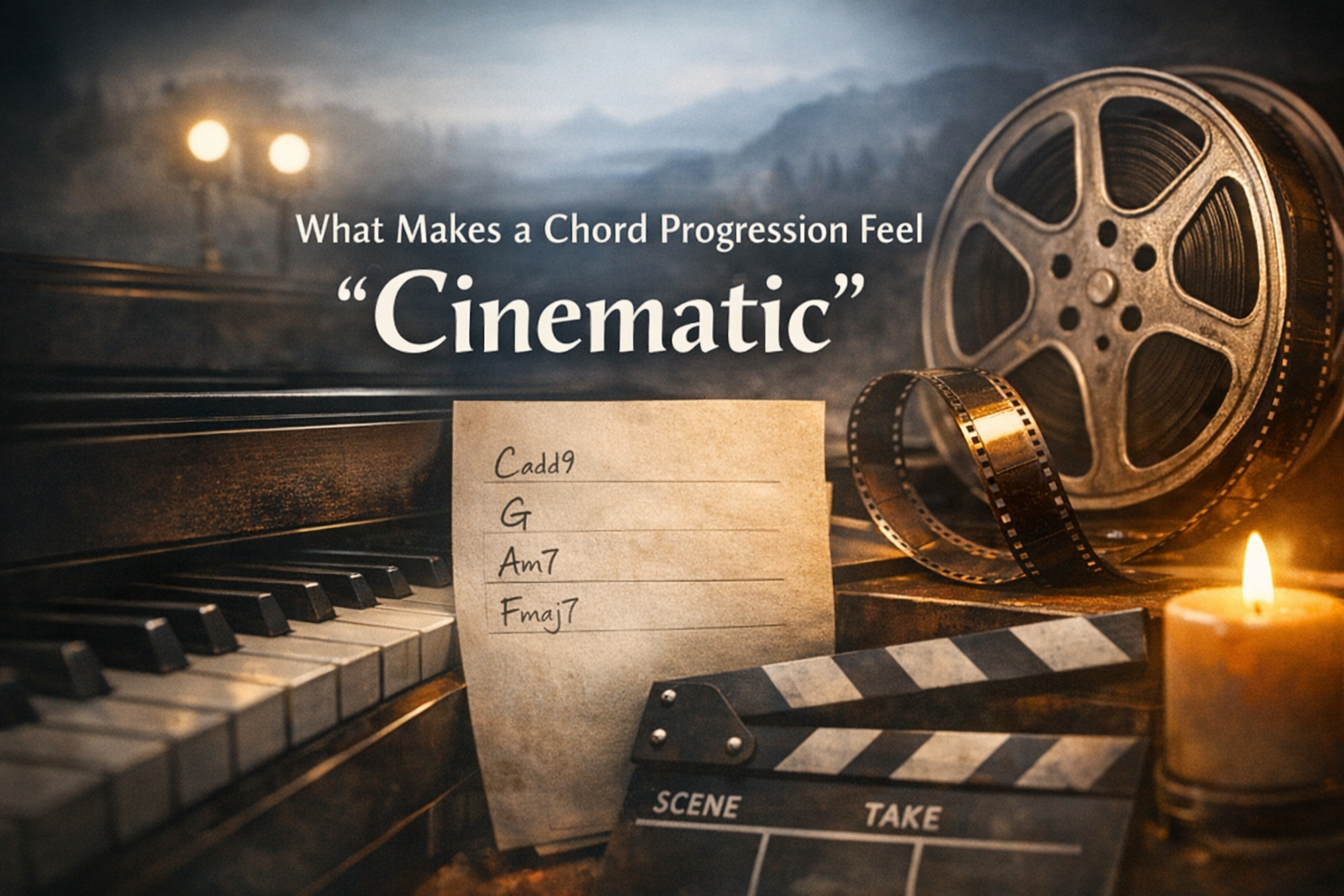
C(add9) → G → Am7 → Fmaj7
Same progression. Completely different feeling.
4. Modal Interchange Creates That “Film Score” Sound
Borrowing chords from parallel modes is one of the most powerful cinematic tools.
In a major key, try introducing chords from the minor version of that key.
Example in C major:
- Use Ab major (borrowed from C minor)
- Use Eb major
- Use Bb major
These unexpected chords add a sense of drama, melancholy, or mystery—without fully leaving the tonal center.
That tension between familiar and unexpected is very cinematic.
5. Bass Movement Shapes the Journey
The bass note is what often gives a progression its sense of direction.
Cinematic progressions frequently use:
- stepwise bass motion
- pedal tones (a constant bass note under changing chords)
- inversions to smooth transitions
A simple trick:
Keep the bass note constant while changing chords above it.
This creates a floating, suspended feeling—very common in film scoring.
6. Dynamics Matter as Much as Harmony
A cinematic progression is rarely static.
Even if the chords repeat, the intensity changes:
- more layers get added
- instruments open up
- register expands
The harmony becomes a foundation for a dynamic arc.
That’s why the same four chords can feel like a loop—or like a story.
7. Resolution Is Often Delayed (or Avoided)
Traditional harmony wants to resolve cleanly back to the “home” chord.
Cinematic progressions often resist that.
They:
- end on unresolved chords
- loop without a strong cadence
- avoid obvious V → I resolution
This creates a sense of openness—like the story isn’t finished yet.
Putting It All Together
A cinematic chord progression isn’t about complexity. It’s about intention.
If you combine:
- slow harmonic rhythm
- smooth voice leading
- extended chord tones
- modal borrowing
- thoughtful bass movement
you can take even the simplest progression and turn it into something that feels like it belongs on screen.
Ultimately, cinematic harmony works because it leaves room—for emotion, for space, and for the listener’s imagination.
And that’s what makes it powerful.