For years, AI in music lived quietly inside DAWs, plugins, and recommendation engines.
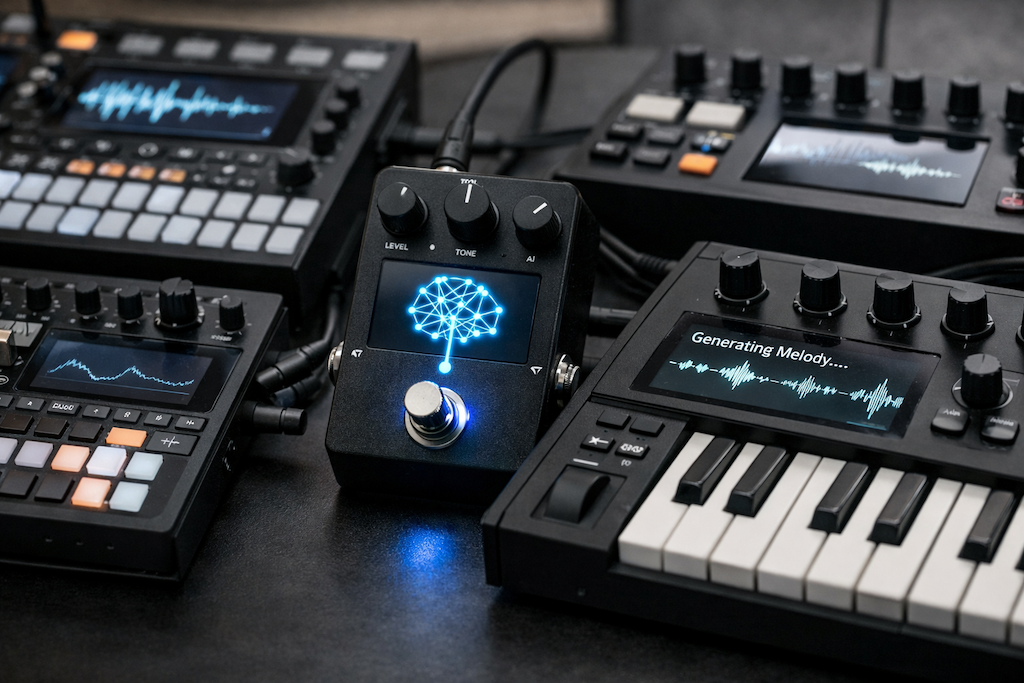
Now it’s stepping out of the screen and into physical gear — synths, pedals, samplers, and even instruments themselves.
And honestly? It’s starting to reshape what “playing music” even means.
The Shift: From Software to Hardware
We’re seeing a clear transition. AI is no longer just something you load — it’s something you touch.
Knobs, pads, strings, and keys are now backed by systems that listen, predict, and respond.
This changes the relationship between musician and instrument. Traditionally, hardware was predictable.
You turn a knob, you get a result. Now, that same knob might influence a system that is actively interpreting your intent.
Smart Instruments Are Becoming Collaborators
Some modern gear doesn’t just generate sound — it reacts to you.
- Adaptive synth engines that evolve based on your playing style
- Drum machines that generate patterns in context
- Loopers that suggest harmonic layers
- Effects pedals that “learn” your tone preferences
This isn’t just automation. It’s closer to co-creation.
Instead of asking “what sound do I want?”, you start asking:
“What happens if I push this system?”
Generative Hardware Is Changing Workflow
Hardware used to be about control and limitation — that’s why people loved it.
But AI introduces a strange paradox: infinite possibility inside finite boxes.
A small groovebox can now:
- Generate chord progressions
- Suggest melodies
- Remix patterns in real time
- Follow tempo and mood automatically
This leads to a different creative flow. Less programming, more reacting.
Less planning, more discovery.
The Tension: Control vs. Surprise
Not everyone is comfortable with this shift.
Musicians often value intentionality. You play something because you mean it.
AI introduces an element of unpredictability that can feel like losing control.
But that unpredictability is also where things get interesting.
Some of the most inspiring moments happen when the machine does something you wouldn’t have thought of —
and you respond to it.
Is This Still “Playing”? Or Something Else?
This is the deeper question.
When your instrument suggests notes, adapts harmonies, or reshapes your sound in real time…
are you still the sole author?
Maybe that’s the wrong way to look at it.
We’ve already accepted collaboration:
- With other musicians
- With producers
- With tools and presets
AI hardware is just another layer — but a much more active one.
What This Means for Musicians
You don’t need to “embrace” or “reject” it completely.
But understanding it will matter.
Because this is likely where things are heading:
- Instruments that adapt to your skill level
- Gear that helps you finish ideas faster
- Systems that blur the line between composing and performing
And maybe most importantly:
Tools that challenge your habits.
Final Thought
AI in musical hardware isn’t about replacing musicians.
It’s about changing the conversation between human and machine.
The question is no longer:
“What can this instrument do?”
But:
“What can we do together?”